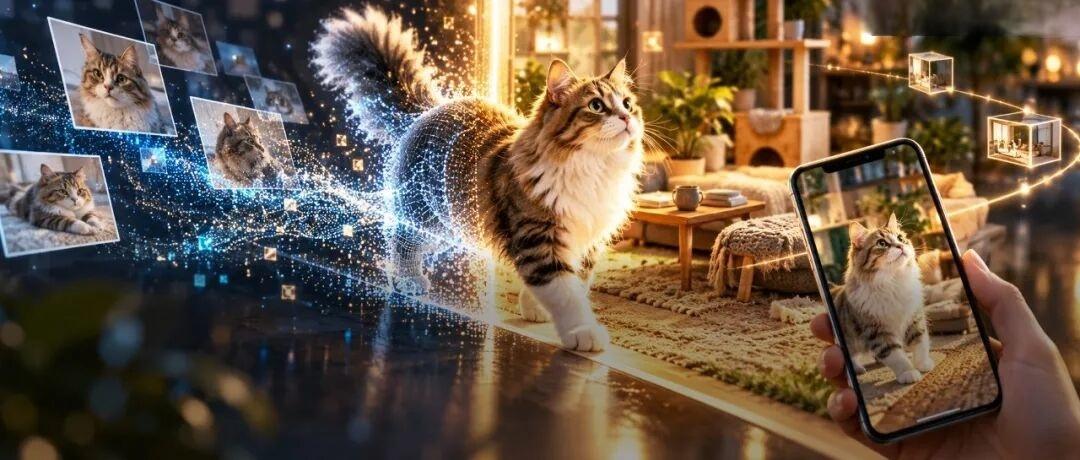
A holiday launch event, a flagship phone, and a single demo app. That is all it took for one of the most consequential shifts in generative AI to land in front of ordinary users.
During a recent product showcase, the new flagship phone line debuted alongside a small, unassuming app — call it Pet Pal — that does something no consumer product has done before. You snap a few photos of your cat, upload them, and a few seconds later your phone contains not a flat picture, not a rotating 3D model, but a four-dimensional digital cat. You can walk around it. You can crouch to its level. Its tail still sways when you are looking at it from the side.
Under the hood sits a native 4D world model called MoWorld, and the company behind it has quietly become the first to push a 4D world model from the lab into a shipping consumer product.
From a Photograph, a World You Can Walk Into
For most of the generative-AI era, AI creating content meant one of two things. A text-to-image model produced a still. A text-to-video model produced a clip. In both cases the camera's path was chosen for you. You could not step sideways to see what was behind the building.
MoWorld treats that limitation as the problem to solve. Feed it a handful of ordinary photos, or a short handheld video, and instead of copying pixels, it tries to understand the scene. Where is the wall? How far away is the table? What is plausibly behind the objects the camera never saw? From that spatial understanding, it expands the flat image into a true 3D volume — and then it adds the fourth dimension.
For a cat, that means the model reasons about its body shape, the texture of its fur, the proportions of its legs. It also reasons about what the cat is doing. If the tail is mid-swing when you take the photo from the front, the swing continues smoothly when you orbit to the side. The cat does not freeze just because you changed your viewing angle.
That is the "4D" — three spatial dimensions plus the temporal, behavioural dimension. The model knows where an object is, what it looks like from every angle, and how its motion should appear across viewpoints and over time.
Beyond the Demo: Where the Moat Actually Lives
The pet app is the friendly entry point, but the more durable story is what is happening across multiple industries.
In film and games, traditional scene-building chains together modelling, texturing, lighting, and animation — each step slow and expensive. A 4D world model compresses pre-visualisation, generates weather variants, swaps props, and re-stages shots without rebuilding. Render pipelines above 500 FPS make high-frame interactive worlds feasible on mobile-class hardware, reducing dependence on top-end GPUs.
In embodied-AI training, robots no longer bash into real walls to learn that walls hurt. A 4D simulation with gravity, collisions, and friction lets policies iterate at machine speed. Failures are virtual. Recovery is instant.
For autonomous driving, the long tail of rare scenarios — black ice, construction zones, a child running across a divided highway — is exactly what simulators generate best. The same 4D asset can be re-lit, re-staged, and re-rendered to produce training data at scale.
And in industrial digital twins and urban planning, the same engine that turns a phone video into a 3D walk-through also lets a factory reconfigure a line, train a remote operator, or rehearse an emergency response without shutting down the physical site.
The value is not "prettier pixels". It is the cheap, repeatable production of reusable 3D/4D assets that actually flow through industry pipelines.
How a 600-Million-Parameter Model Lives Inside a Phone
A model this ambitious should not fit on a phone. It barely fits on a server rack. The trick is a deliberate cloud–edge split. The heavy lifting — generating a high-quality 3D Gaussian representation on the server using a domestic AI accelerator — runs in the data centre. Then a compact MoWorld-2.0-Flash, roughly 600 million parameters after aggressive quantisation and operator-level adaptation to the phone's neural processing unit, handles the final real-time rendering on the device.
End-to-end, the pipeline runs on domestic hardware: training on a Chinese accelerator, server-side inference on the same family, edge rendering on the phone's own silicon. Independent estimates put the inference cost at about 30 percent of an equivalent foreign-GPU stack. A 70 percent cost reduction is what makes mass deployment of a world model economically viable, not just technically possible. That is the unglamorous, decisive engineering that turns a research demo into a product.
From Pretty Pictures to Physics
Visual fidelity is table stakes. What separates a world model from a graphics engine is whether it obeys physical laws. Recent releases added explicit modelling of gravity, elasticity, rigidity, and external forces. Kick a virtual football and it rolls and bounces. Brush past a flower and it sways.
Render throughput has climbed to over 500 FPS for 3D/4D Gaussian assets, with phone-side performance above 100 FPS — smooth enough for direct manipulation without a headset. The outputs are now interoperable. Generated assets export cleanly to game engines, virtual-production pipelines, digital-twin platforms, and robotics simulators. Generate once, import everywhere. Scenes can be edited in place: add a streetlamp, remove a parked car, change the season.
Stack those capabilities together and the system is no longer an AI that draws. It is a small, physically literate parallel world, running locally.
The Global Picture
It is useful to position this against other recent entrants. A notable Western competitor, released earlier this year, demonstrated that a small number of photographs can be lifted into a navigable 3D scene. The approach is impressive and has helped put world models on the broader AI map.
Where the two differ is where the frontier sits. The Western system focuses primarily on static 3D structure. The system described here treats time as a first-class dimension. It bakes in physics. And it has a credible path to running on consumer devices at meaningful scale, with cost economics that competing stacks cannot match. If the former represents the international state of the art for spatial understanding, the latter is beginning to look like a more complete answer to the question world models are ultimately for: not just depicting space, but letting people and machines interact with it.
What This Means Beyond the Hype
For two years, world models have been a fixture of keynote slides. They look stunning in controlled demos. The harder question — when does an ordinary person get to use one? — has gone mostly unanswered. A consumer app that lets you re-create your pet in 4D, on the phone already in your pocket, is the first honest answer. It is small, playful, and exactly the kind of product that makes a heavy research concept feel ordinary.
That is the part worth paying attention to. The most disruptive technologies rarely arrive with a bang. They arrive as a feature in a phone, then quietly become infrastructure.