
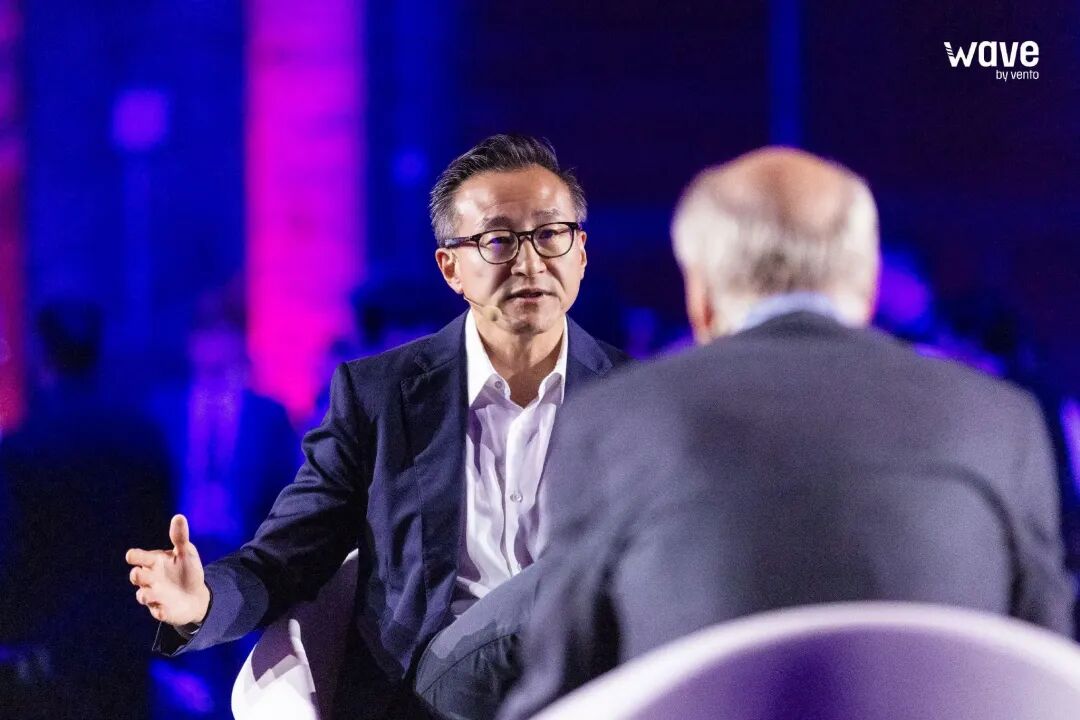
A routine fireside chat at an Italian tech summit turned into one of the clearest public roadmaps for AI in five years.
At the Wave by Vento 2026 summit in Turin, Alibaba's Joe Tsai spent an hour explaining how he sees the next five years unfolding. The talk ran from the future of AI itself, through Alibaba's full-stack ambitions, to a candid assessment of Europe and a pointed comparison between open-source and closed labs. Almost every major question the industry is currently debating was on the table.
Tsai opened with one prediction: in five years, people will stop talking about AI as a separate category. It will be like the internet today — so embedded into every product and workflow that nobody bothers to mention it.
That sounds like a small framing choice. It is not. The debates that dominate current coverage — is AI useful, is AI a bubble — all assume that AI is a discrete thing to be evaluated. Tsai's argument is that once something becomes infrastructure, that question dissolves. People stopped arguing about whether the internet was useful somewhere around 2002. The same dynamic will apply to AI.
The substance of his argument is that AI is moving from being a product to being a substrate. A capability that quietly sits under every business function. In five years, the most consequential AI will not be the one with the highest benchmark score. It will be the one that has become boring.
Two Eras at Alibaba
Tsai split Alibaba's history into two eras. The first ran from 1999 to 2023 — the e-commerce expansion era. Scale, traffic, merchant acquisition, the entire playbook that made the company what it is today.
The second era starts in 2023. From that point on, the company has exactly two priorities: e-commerce and full-stack AI. Not AI as a feature. AI as the second pillar of the business, alongside commerce.
The structure he described is the one every serious AI company is now chasing: silicon at the bottom, models in the middle, applications on top. But the difference at Alibaba is that all three layers live inside one company. The models run on Alibaba's own cloud; the cloud runs on domestic AI accelerators; the accelerators feed the merchant, logistics, and recommendation systems that drive the commerce business.
That tight loop is the point. A lab that only trains models is at the mercy of whoever owns the compute. A cloud provider that only resells compute is at the mercy of whoever owns the models. Alibaba runs both sides of that equation and, crucially, has a real product to deploy against. Every new model capability lands inside Taobao, Tmall, Cainiao logistics, or the enterprise cloud within weeks.
The Europe Question
Asked about Europe's AI strategy, Tsai gave an answer that is likely to be quoted for some time. Europe does not need to choose between the US and China. The fastest path to AI autonomy is open-source models combined with domestic compute. Anything less leaves the continent dependent on someone else's silicon and someone else's licensing decisions.
But, he argued, open-source models alone are not enough. Europe also needs to build out its own data-center capacity and a domestic cloud industry. He pointed to two specific advantages Europe already has: roughly twenty to thirty percent of the world's top AI researchers are European, and the continent's deep industrial base produces the kind of high-value, hard-to-replicate data that today's models actually need.
The implicit target is the regulation-heavy-but-capital-shy approach that has kept Europe's AI sector small. Open-source is cheap to license. Industrial data is already there. The missing pieces — compute, capital, and a willingness to ship — are the ones European policymakers can actually influence.
Open Versus Closed
The most pointed part of the talk came near the end, when Tsai drew a sharp contrast between US and Chinese AI labs. The leading American labs, he argued, are increasingly closed. Frontier research is no longer being published; model weights are no longer being released. Chinese labs are doing the opposite: open weights, open recipes, aggressive publication.
He compared the closed approach to locking down a research university. The open approach, he suggested, is closer to how great universities have always worked — publish everything, train everyone, let the best ideas win on merit. In the short term, openness might look like ceding a competitive edge. In the long term, openness is the only way to build an ecosystem large enough to matter.
Tsai also returned to the manufacturing argument that has become a Chinese talking point. China accounts for roughly thirty percent of global industrial production. The data produced inside those factories — yield rates, defect classifications, machine parameters — is exactly the kind of high-quality, structured, hard-to-collect signal that turns a generic foundation model into a specialist in process optimisation or materials design.
Pair that with China's full hardware supply chain — from EVs to industrial robots — and the country's AI bet looks less like a copy of Silicon Valley and more like a different game entirely. The objective is not to ship the best chatbot. It is to embed AI into the physical economy that already runs at scale.
The Long Run
Tsai closed with the kind of line that travels. AI is a long-distance race. The winners will not be the ones with the loudest launches or the most dramatic demos. They will be the ones whose foundations are the most solid and whose integration with the real economy is the deepest.
It was an unusually calm speech for an unusually loud industry. No hype about artificial general intelligence, no sweeping promises about replacing human cognition. Just a careful description of how a major company plans to keep doing what it has done for twenty-five years: build infrastructure, ship product, and let scale do the rest.
If the AI bubble bursts next year, the Tsai playbook survives. If AI becomes the next electricity, the Tsai playbook still survives. Either way, full-stack is the only AI strategy that pays off in both scenarios.