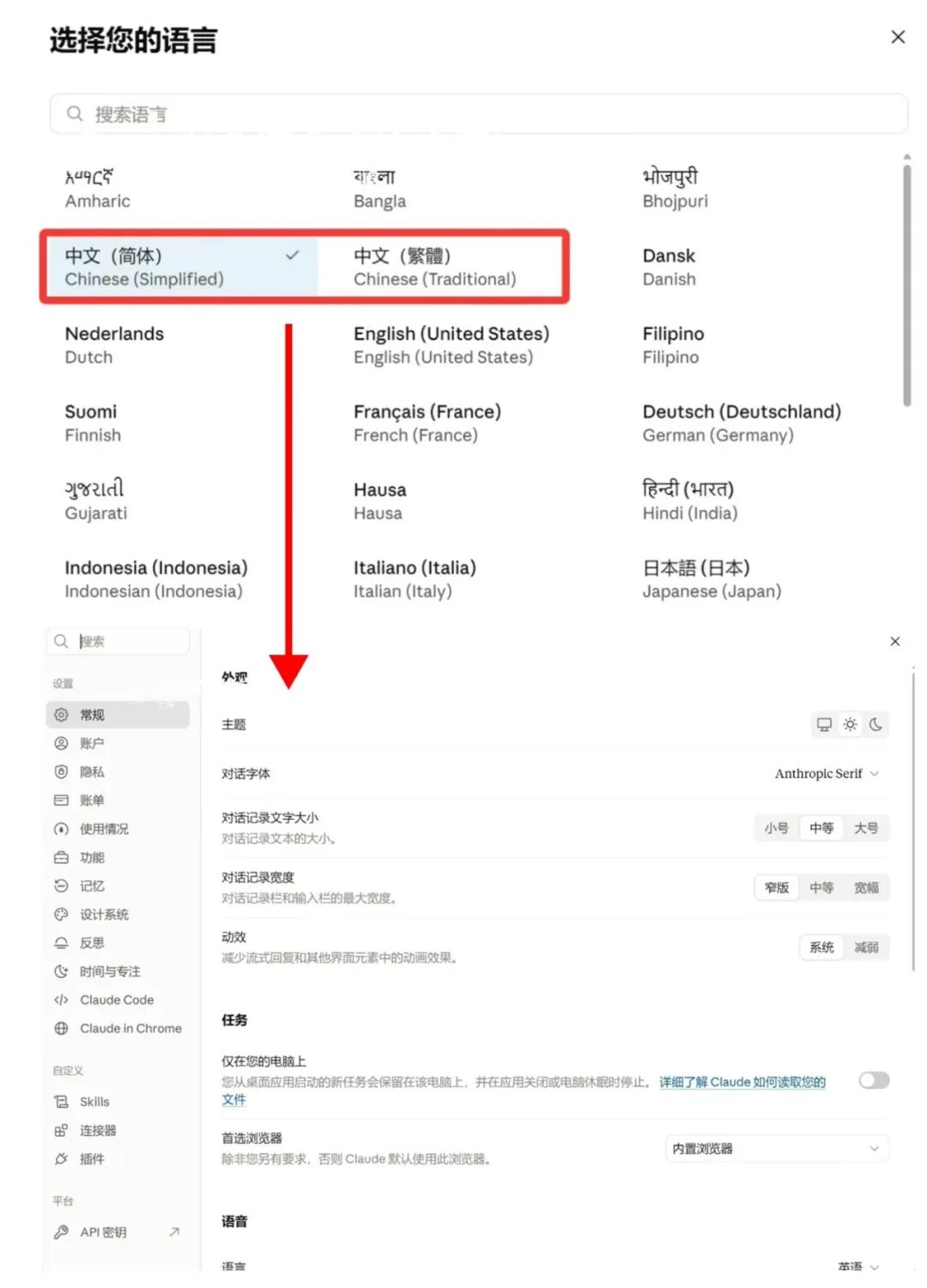
Claude is suddenly speaking Chinese. The first reaction from one corner of the internet was not celebration but suspicion: this looks like another sting operation.
Over the past few days, both the web and desktop clients have begun presenting a "Choose your language" prompt. Simplified Chinese sits there with a check mark next to it; Traditional Chinese sits beside it. The buttons, the menus, the settings panel — the entire interface renders in Chinese. The full language list stretches past thirty entries. Web and desktop lead; the mobile apps have not caught up yet.
The more surprising detail is on the checkout page. The country selector in the billing flow now includes China, with the $20 Pro plan and the $200 Max plan both selectable. Long-time observers of the platform reacted with one sentence: be careful, this looks like the latest trap.
A Pattern of Sting Operations
The wariness is earned. It is the third episode in a recurring series.
Earlier in the autumn, Claude distributed a promotional $250 in usage credit. Some users accepted the offer in the morning, connected a code-hosting account, and by lunchtime received a terse account-suspension email from the security team. The stated reason fit on one line: violation of the supported-region policy. The community summary was pithier: the early bird gets the worm, the early claimant gets the ban.
Then came a merchandise giveaway. The shipping form's country selector, when set to China, surfaced an extra field labelled "National ID Card Number". An orange plush toy in exchange for an eighteen-digit identity document. Customers could do the math themselves.
From $250 in credit, to merchandise, to a translated interface, the community has come to expect the same pattern. Season three of what one observer called entrapment-as-a-service.
The Door Is Still Locked
The same observers who flagged the checkout-page change walked it back quickly. Yes, the dropdown was real. That is the extent of it.
The official supported-region document still lists countries alphabetically from C in a very specific way. Chile appears. Colombia appears. Mainland China, Hong Kong, and Macao do not.
A dropdown menu does not rewrite a policy document. If the company were actually opening access, the change would be visible in the documentation, in the support pages, in a public announcement. None of those have appeared.
The company's posture toward China has, if anything, hardened over the past year. Roughly twelve months ago, any organisation with more than fifty-percent Chinese-ownership was ruled ineligible to purchase. More recently, official guidance explicitly forbade any attempt to access Claude from unsupported regions. Identity verification now requires an original government-issued document plus a real-time selfie; scanned copies and photo-of-photo submissions are routinely rejected. The chief executive has personally endorsed export controls targeting China.
In other words, the language switch is cosmetic in every direction that matters.
Who the Chinese Interface Is Actually For
There is, however, a real audience for the change. It is just not the audience the dropdown seems to suggest.
Chinese-speaking communities outside the mainland have been Claude users for years. Ethnic-Chinese communities in Singapore and Malaysia have long accounted for a meaningful slice of consumer demand. Chinese students studying in the United States, the United Kingdom, and Australia are a substantial user segment. For all of them, the platform has until now meant navigating an English-only interface in their second or third language.
It is not as if Claude has been ignoring Chinese entirely. The help documentation has long offered a Simplified Chinese translation. Voice conversations have been able to speak Mandarin for some time. The web interface itself was simply the last surface to catch up.
The reason it caught up now is straightforward. Claude is in a hurry to broaden its appeal. In the most recent high-profile ranking of consumer-AI products, Claude's revenue jumped to second place. The once-commanding lead that the leading competitor held over Claude in U.S. paid subscribers has narrowed from roughly eight-to-one to about three-to-one. The strategic gap is shrinking fast.
The complication is the audience composition. Of all the new capabilities Claude has shipped over the past six months, only a small fraction have been aimed at non-technical consumers. To convert from a programmer-favourite into a mainstream product, the first practical step is letting ordinary users read the menus.
What Mainland Users Will Hear
For users inside the mainland, the new interface is a translation of a door that remains shut. No matter how fluently Claude can now write in Mandarin, the only sentence it is willing to deliver to that audience is: this region is currently not supported.
The episode is a useful illustration of how product decisions and policy decisions sit in different rooms. A localisation team can ship thirty-two language packs in a sprint. The compliance team can take eighteen months to decide whether a single country moves from a closed list to an open one. The two timelines do not have to align, and they rarely do.
What Chinese-speaking users outside the mainland will get is the more interesting story. A platform that, for the first time, greets them in their own language, even as the map of where it is allowed to operate quietly stays the same.
The Broader Pattern: Localisation Outruns Liberalisation
The episode is also a small case study in how global AI products get rolled out in 2026. The technical work of supporting a new language is largely a solved problem. Translation pipelines, locale-aware formatting, and culturally-aware copy review are mature tooling. Shipping thirty new language packs in a single sprint is now a routine deliverable for any serious consumer product team.
Deciding who is allowed to use the product, by contrast, has become a more conservative and slower-moving exercise. Export controls, sanctions alignment, content-policy enforcement, and identity-verification standards have all tightened across the industry. For frontier AI labs with global ambitions, the default posture in restricted markets has shifted from "ship first, comply later" to "comply first, ship only when cleared".
The two halves of the product organisation now operate on different clocks. Localisation moves at internet speed. Geopolitical clearance moves at diplomatic speed. The result is the situation Claude users encountered this week: a thoroughly translated product whose map of legal users has not moved an inch.
For the diaspora audience the localisation is genuinely intended for, that mismatch is acceptable. For anyone hoping the language switch signalled a policy shift, it was a useful reminder that a dropdown is just a dropdown.