
Predicting AI's trajectory is a fool's errand. The pattern is so consistent that it is itself a phenomenon — five paradoxes that the industry has not been able to escape.
The Prediction Paradox
Nobel laureates, Turing Award winners, founders, and chief economists all confidently make predictions about AI that turn out to be wrong. The track record is bad in both directions. People are too optimistic and too pessimistic, with similar frequency.
Marvin Minsky predicted in 1970 that a machine with average human intelligence would exist within three to eight years. Geoffrey Hinton said in 2016 that the training of radiologists should be stopped immediately, because deep learning would exceed radiologist performance within five years. The actual outcome was almost the opposite — radiologist employment and pay in the United States have both risen sharply over the past decade.
Demis Hassabis said in 2025 that AI would help cure all diseases within a decade. Dario Amodei said in the same year that AI would roughly double the human lifespan within five to ten years.
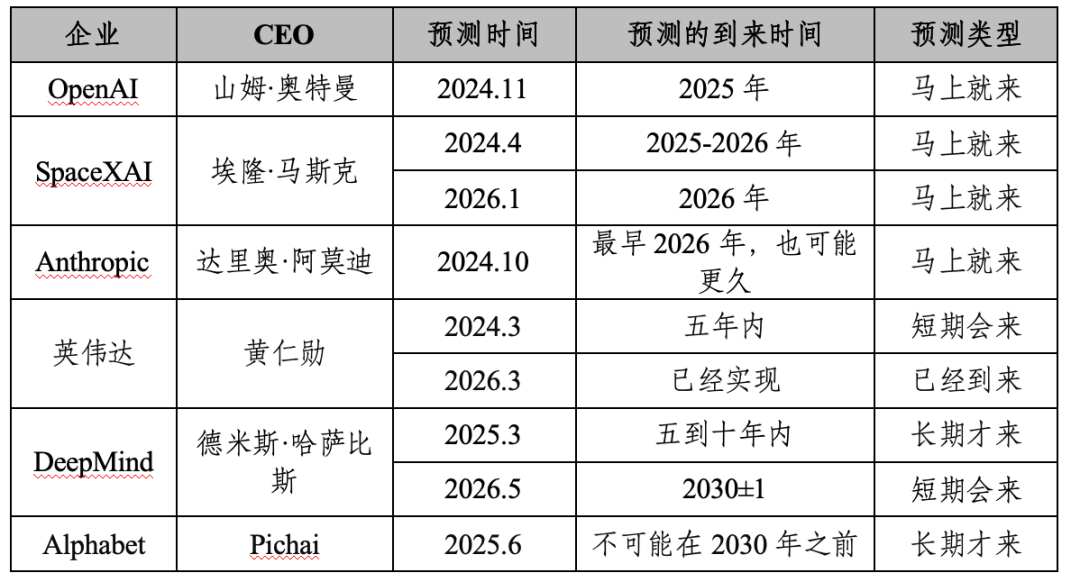
On AGI specifically, the predictions are wildly dispersed. Some founders say AGI has already arrived. Some say it will arrive in a year or two. Some say three to five. Some say five to ten. Some scholars say AGI is a non-question and will never arrive.
Why does this happen? The honest answer is that nobody actually knows. People make predictions for different reasons — promotion, fundraising, paper citations, motivated argument. The future does not follow anyone's script. A placid pig cannot predict the Spring Festival surprise.
The Employment Paradox
The second paradox is the volume of confident numbers. The OECD, IMF, World Economic Forum, UNCTAD, ILO, World Bank, Goldman Sachs, McKinsey, and Pew have all published estimates of AI's impact on employment. The numbers range from roughly zero to roughly seventy percent of jobs affected.
Single reports can be persuasive. Read together, they are bewildering. The difference between four-tenths of one percent and sixty-seven percent of jobs is the difference between a footnote and a civilisational rupture.
The pre-condition for any defensible employment estimate is an accurate forecast of where AI technology is going. As the first paradox shows, that forecast is unreliable. Layered on top is the fact that AI is not the only thing that affects employment. Business cycles, demographics, industrial policy, immigration, trade, and random shocks all combine. Separating AI's contribution from the rest is structurally impossible. Quantitative estimates are most useful as evidence of how little we know, and least useful as guides to action.
The Productivity Paradox
The third paradox is older than AI. In 1987, Robert Solow observed that you can see the computer age everywhere but in the productivity statistics. The formulation became known as the Solow Paradox. Forty years later, AI is producing the same phenomenon.
EU hourly labour productivity has hovered near zero since ChatGPT's release. Of the fourteen quarters from late 2022 to early 2026, only three saw productivity growth above the long-run average of one percent. The US has done better — non-farm business productivity has averaged roughly two point two percent annually over the same period — but that figure is essentially the long-run historical average, not an AI-induced breakthrough.
Three explanations are available. Wrong expectations, measurement error, or time lag. The third, the J-curve described by Erik Brynjolfsson, in which general-purpose technologies require substantial complementary investment and organisational change before their productivity impact materialises, is the most persuasive. Steam engines took roughly fifty-four years from commercialisation to productivity impact. Electric motors took forty. Computers took twenty-one.
The Data Paradox
Data has been called the new oil, the most valuable resource in the world, and a category on par with energy and raw materials. It is also, paradoxically, almost impossible to monetise.
OECD policy reviews across forty-six countries show that governments talk about data in the contexts of innovation, trust, society, market openness, utilisation, and access. They do not talk about transaction. Data exchanges have proliferated; transactions on data exchanges have not.
The value of data only materialises in use. Once data has been used to train a model, the data itself is not consumed. It can be used again. It does not depreciate the way a barrel of oil does. It also does not have a price tag. In the most recent disclosed balance-sheet figures, only two and a half percent of A-share listed companies have recorded any data resource at all. The total recorded value across the entire market is roughly zero point three percent of China's core AI industry revenue.
The paradox is structural. Data is the indispensable input to the most consequential technology of the decade. It is also almost invisible in the financial system that supposedly values inputs. The accounting has not caught up. The pricing mechanism has not been built.
The Industrial Revolution Paradox
The fifth paradox is rhetorical. Every major technology of the past half century has, at some point, been proclaimed as the fourth industrial revolution. The list runs through microelectronics, computing, nanotechnology, the internet, alternative energy, cyber-physical systems, big data, AI, the internet of things, the industrial internet, blockchain, quantum computing, and smart manufacturing.
Each proclamation is implicitly a retraction of the previous one. If AI is the fourth industrial revolution, then the blockchain, the internet of things, and the cyber-physical systems were not. The annual count of candidates has accelerated so much that being declared a revolution has lost almost all information value.
Two more sober observations are worth making. The first is that industrial revolutions and economic crises cannot coincide. The second is that industrial revolutions are identified retrospectively, not in real time. The phrase industrial revolution entered common use roughly forty years after the first one ended. The people who lived through them did not know they were living through them.
If history is a guide, the fourth industrial revolution will not be officially named until sometime in the 2060s. Until then, the term is best understood as a press-release convention rather than as an analytical claim.
Why the Paradoxes Matter Together
Read individually, each paradox is a curiosity. Read together, they describe something structural. The people closest to the technology cannot reliably predict where it goes. The institutions trying to measure its social impact cannot agree on a number. The productivity gains that should be visible everywhere are nowhere in the statistics. The most valuable input to the technology has no market price. And the term used to describe the historical moment has lost meaning.
The honest conclusion is uncomfortable. AI is the most consequential general-purpose technology of the past forty years, and we do not have reliable methods to predict where it goes, measure what it does, price what it consumes, or describe the era it is creating.
The right response is not pessimism or optimism. It is humility, and patience. The Solow Paradox took roughly fifteen years to resolve. The data paradox may take longer. The industrial-revolution paradox may take forty.
Anyone who tells you the answer to any of these questions in advance is selling something.