
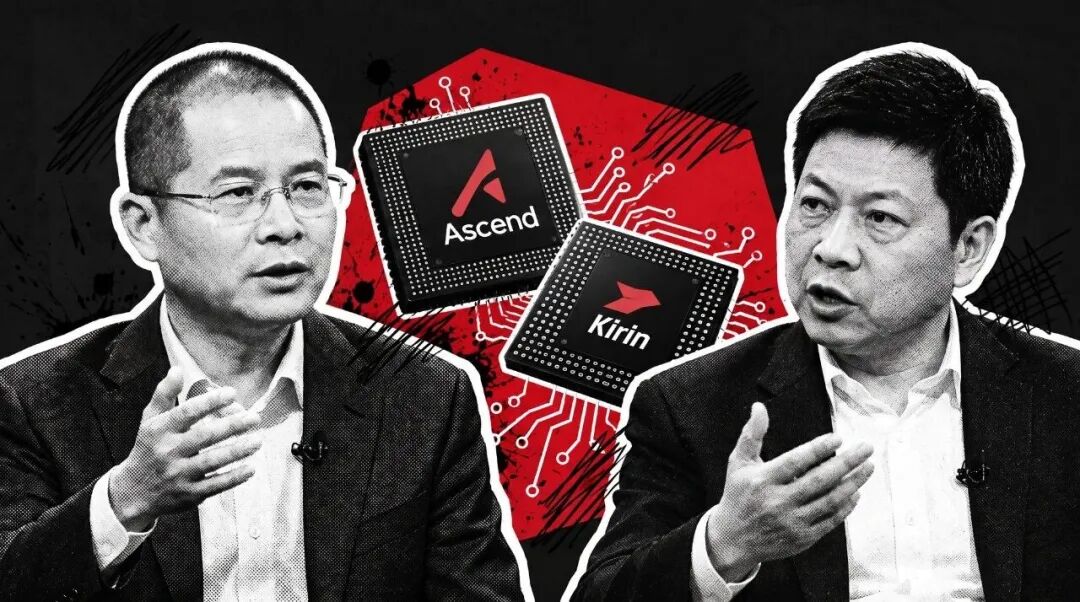
The conversation about AI competition has shifted from models to the substrate beneath them. That changes what Huawei has to do.
For most of the past three years, the public AI competition has been told as a model story. Which lab released the most capable system. Which benchmark was topped this quarter. Which company crossed the next parameter threshold first.
What the latest figures from the International Energy Agency make clear is that this framing no longer holds. Five of the largest technology companies spent more than four hundred billion dollars on capital expenditure in 2025, with another seventy-five percent increase expected in 2026. AI is now a capital-intensive, energy-intensive, infrastructure-intensive industry.
The shift has a consequence that is rarely discussed in public. The basic unit of AI competition has been moving up. It used to be a single GPU. Then a chip-plus-memory subsystem. Then a server. Then a data-centre hall. Now it is the entire grid connection behind the data centre.
That is where Huawei's strategy starts to make sense.
From Chip to System
Single-chip performance used to define an AI hardware competition. Process node, peak FLOPS, memory bandwidth. Those numbers still matter. They have just stopped being sufficient.
Once thousands of accelerators are running the same training or inference workload, the metric that matters is no longer what one chip can do at peak. It is what the whole system can deliver continuously. Inter-chip bandwidth, memory access patterns, network topology, job scheduling, fault tolerance, power delivery, cooling — all of them now sit on the critical path.
For Huawei, that is mostly good news. If the race were still about single-chip performance, the company would be facing the same uphill climb it has been on for the past five years. Advanced process nodes, high-bandwidth memory, packaging capacity, and foundry access would each be a binding constraint.
Once the race is about system-level performance, the company has a different lever. Its expertise in communications, optical networks, and large-scale system integration suddenly becomes the binding constraint on everyone else.
The Super-Node Bet
At its 2026 Connect conference, Huawei outlined the strategic shape of the next several years. The centrepiece is a super-node plus cluster architecture. Beyond squeezing more out of each chip, can system-level innovation organise more chips into something more efficient?
The stack has four layers. Super-node architecture organises a large number of Ascend accelerators into a single logical compute unit. High-speed interconnect — UnifiedBus, all-optical networking — removes the data-exchange bottleneck. Cluster architecture strings super-nodes together into data-centre-scale systems. Software orchestration, storage, fault tolerance, and energy management sit above all of it.
The phrase system innovation is doing a lot of work here. What Huawei means by it is essentially the entire organising principle above the silicon.
The Black Soil
Huawei's preferred metaphor is black soil. The base technology platform — Kunpeng general-purpose compute, Ascend accelerators, base software, cloud infrastructure — provides the underlying environment. Partners grow models and industry applications on top.
The metaphor is useful because it surfaces a deeper question. Infrastructure is valuable because of what other people can build on it. The right test of an infrastructure is not whether it is fast in isolation, but whether it can host a large enough community of independent innovation that the platform becomes more valuable as the community grows.
That is the part Huawei finds hardest. Nvidia's deepest moat is CUDA — fifteen years of developer tooling, libraries, performance optimisations, and existing code. CANN, Huawei's equivalent, is improving quickly. But each migration still requires library adaptation or kernel-level tuning. The migration cost is real, and it is what keeps CUDA sticky even when individual Nvidia chips face real competition.
DeepSeek, Going Down
In late September 2026, the collaboration between DeepSeek and Huawei moved from model-running on Ascend to model-defining the underlying software. The two teams are jointly developing and open-sourcing a series of low-level programming tools aimed at making Ascend easier to use and optimise.
This is more than a Chinese model being adapted to Chinese silicon. Model vendors are now helping design the programming tools, communication libraries, and operator kernels that the entire developer ecosystem will sit on.
The shift is best understood as a feedback loop. Model improvements create new compute, communication, and software demands. Those demands push Ascend and its tooling to improve. Better silicon opens up new model possibilities, which feed back into the loop.
AMD, Going Up
On September 28, AMD announced an eight-point-two-billion-dollar all-stock acquisition of the World Labs research group led by Fei-Fei Li. The official rationale was direct. As AI moves into reasoning, robotics, simulation, and physical AI, the workloads facing compute infrastructure will look very different from the ones it was designed for.
AMD is moving up the stack. DeepSeek is moving down. The directions are opposite. The conclusion is the same. The line between model provider and compute provider is no longer fixed.
The Energy Layer
The feedback loop extends one layer further down. Data-centre electricity demand is rising so fast that energy has stopped being a back-office concern and started being a binding constraint on expansion.
The new reality is that frontier AI is increasingly an infrastructure-intensive industry. Models can iterate in months. Chip design and manufacturing take years. Data-centre construction takes longer. The technology stack now has multiple time scales running in parallel, and the slowest of them sets the ceiling.
The Hand
Strip the strategic noise away and Huawei's position is clearer than it looks. The first card is still Ascend. The second is interconnect and systems engineering. The third is the broad ICT portfolio — Kunpeng, storage, networking, data centres, and digital energy — that lets Huawei design AI systems at a scale beyond the single chip. The fourth is the emerging software and model ecosystem, including CANN's opening and DeepSeek's involvement in low-level tooling.
The fourth card is the weakest. The first three can be advanced by Huawei's own R&D. The fourth cannot be built by any one company.
The cards Huawei is missing are equally clear. Advanced fabrication. The accumulated CUDA ecosystem, with its libraries, tooling, and developer base. And large-scale system engineering carries its own costs — communication, power, cooling, reliability, and operations all scale worse than the chip count.
The Real Test
Strip everything down and the question is concrete. Can a large Ascend cluster run reliably for months at a time? What fraction of peak compute survives the translation to actual model training and inference? How does the energy efficiency compare on the same workload? How painful is developer migration?
Those questions are not glamorous. They are also the only ones that matter. Huawei is betting that the answer is positive. The bet is about whether, when AI competition moves from devices to systems to ecosystems to infrastructure, the company's accumulated strengths in communications, optics, storage, and energy will turn into a durable advantage.
That is what each layer is doing — chip performance as the floor, system architecture as the multiplier. The bet is that, when AI competition moves from devices to systems to ecosystems to infrastructure, Huawei's accumulated strengths will turn into a durable advantage.