
The story begins with a nine-year-old delivering the cruelest sentence a child can deliver to a mathematician.
Scott Aaronson's son leaned into the room. Mom, he said, I heard you got wrecked. I heard a robot solved a math problem you'd spent your whole career on. Yikes.
The mother is Dana Moshkovitz, a complexity theorist at a leading US computer-science department. The career-defining problem in question was the Unique Games Conjecture, one of the deepest open questions in theoretical computer science. On October 6, OpenAI released a manuscript that appears to settle it.
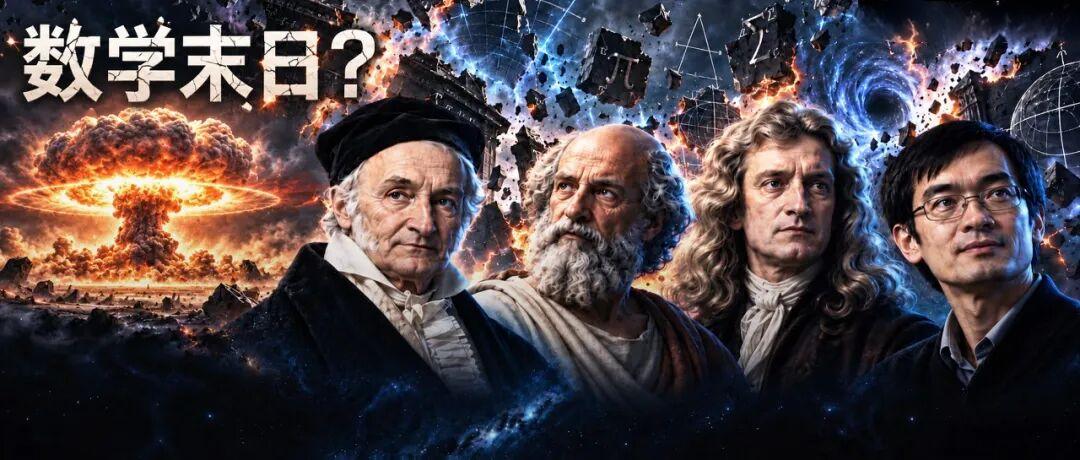
Aaronson — Dana's husband, also a leading complexity theorist — wrote up the moment as the end of math. The phrase is hyperbolic. The event it describes is not.
The 722-Manuscript Release
On a single Monday in October, OpenAI published 722 separate mathematical manuscripts. Each one represents a complete proof of a problem that had previously been open. Each one was generated by the company's most capable internal reasoning model. Each one took, on average, roughly three hours of compute.
The list is not a marketing document. It includes L = BPL, the long-standing conjecture that probabilistic log-space equals deterministic log-space. It includes a new bound for matrix multiplication that improves the long-stuck exponent. It includes a Fourier-transform result that breaks through a barrier from the 1960s.
Most of the individual results would, in a normal month, be a featured paper at a leading venue. The list, in aggregate, is something mathematics has not seen before.
The Manuscripts Are Unreadable
The story Aaronson tells is that the proofs are technically correct. They are also written in a style that no human mathematician can follow without help.
After reading the Unique Games manuscript, Dana's description was that it read like something written by someone on hallucinogens. The proof invents an entirely new error-correcting code with noise testing built in. The code is neither long nor short. It is some kind of alien structure that does not fit any of the categories humans have learned to recognise.
The mathematical content is presented with broken citation, fragmented references, and logical jumps that do not match human intuition. The community's working response has been to feed the manuscript into another AI and ask the second model to translate the first model's proof into something a human can verify.
The result is the most unusual scene in the history of modern mathematics. Human mathematicians are no longer the producers of results. They are the curators, the archaeologists, and the translators of an alien mathematical culture that AI is producing faster than they can read it.
The Resistance
The community response has hardened quickly. The Association for Mathematical Honesty — an informal coalition of leading mathematicians, formed earlier this year — issued a joint statement coordinated through Terence Tao's blog. The statement did not pull punches. Yesterday, it said, OpenAI — a company currently defending itself against accusations of illegal copying, copyright infringement, and trademark dilution — released a batch of manuscripts. The release, the statement continued, was naked compute hegemony.
The substantive demand was simple. Nobody asked you to do this work. Nobody asked you to solve these proofs. The statement called on mathematicians to stop cooperating with OpenAI and return to a research culture centred on human understanding.
The counter-position, expressed by a Turing Award laureate, is that the resistance is missing the point. Formal proof will be heavily automated. That does not make mathematicians obsolete. The future of mathematical research is in choosing which problems to attack, inventing the abstractions needed to make progress, and articulating the new questions worth asking.
The Relieved
One of the more striking responses came from a mathematician who had spent years on three problems OpenAI's release appears to have solved. His reaction was relief. He did not feel robbed. He felt unburdened. He had spent years proving that his intuitions were right. The machine had done the last mile. He could finally move on.
The response is more common than the official line suggests. A non-trivial fraction of working mathematicians are spending their careers on problems whose resolution, one way or the other, would benefit from a closed-form proof they personally will never reach. The arrival of a tool that closes those proofs is, for some of them, a gift.
The Cryptography Question
The most unsettling detail in the release is one that almost no one is publicly discussing.
The 722 manuscripts cover number theory, combinatorics, quantum complexity, and most of the standard landscape of pure mathematics. They do not, conspicuously, cover cryptography.
According to Aaronson, the major AI labs are now actively investigating whether their latest reasoning models can break the cryptographic protocols that secure modern communications. The reasoning is straightforward. If AI can independently invent error-correcting codes that human mathematicians cannot read, the question of what those same models can do to cryptographic primitives is not academic.
If they have already been broken, the labs want to know before anyone else does. That is the work that is happening behind closed doors right now.
The implication, left unstated, is chilling. If AI has silently broken the foundations of public-key cryptography, the banks, the certificate authorities, the national security infrastructure, and the encrypted web itself are running on assumptions that no longer hold.
What Aaronson Did Next
Aaronson ended his essay by describing what he did on the night of October 6. He did not try to read more manuscripts. He did not attempt to verify more proofs. He sat down with his children and watched a movie.
The movie was Terminator 2.
He chose it deliberately. The film offers the most concrete instruction available on what to do when an intelligence superior to your own decides to act. You teach your children what survival looks like. You accept that some things are out of your hands. You hope the better version of the future is the one that gets here first.
The Line the Community Has to Hold
The dispute inside mathematics now has a clear shape. The optimists argue that AI is opening up new mathematical territory that humans could not reach on their own, and that the right response is to repurpose the human role toward problem selection and conceptual framing. The pessimists argue that the velocity of machine proof has decoupled from the velocity of human understanding, and that the gap is now too wide to close without deliberate, sustained restraint.
Both views are partially correct. The optimists are right that the proofs are real and that the resulting mathematics is valuable. The pessimists are right that no human community can absorb 722 unverified proofs in a meaningful timeframe, and that the absence of meaningful human absorption is itself a problem.
The compromise position that some institutions are now adopting is to insist on slower, journal-mediated publication. One proof at a time. Real refereeing. Human-readable exposition. The position will not stop the technical progress. It might, at the margin, slow the publication velocity enough to give the community time to catch up.
It is a thin reed to lean on. But mathematics has survived thinner reeds before.