For two thousand years, mathematics has been a solitary climb. The sharpest minds in each generation picked a peak, packed a notebook, and went up alone. Euclid, Gauss, Hilbert, Wiles: every name a flag on a different summit. The new claim is that this era is over.
The argument arrived in a long essay that ricocheted across the AI and mathematics communities within hours of publication. Its author is a senior figure in the field — a long-time architect of modern deep learning who now sits among the founding members of one of the most-watched AI labs. His thesis, titled Where Is Mathematics Going?, is unambiguous: the lonely-climber era is ending. The era of surveying the whole continent has begun. Mathematics, in his words, has graduated.
A Decade-Old Bet, Now Coming Due
The author has been preparing for this moment for most of his career. He attended the most demanding mathematics programme available as a teenager. He later earned a doctorate in applied mathematics in Germany, then spent more than a decade inside one of the largest industrial research labs in the world.
His fingerprints are on several foundational artefacts of modern deep learning: a landmark image-recognition architecture; the first rigorous demonstration that small, carefully crafted perturbations could reliably fool neural networks; and a normalisation technique that is now a default ingredient in essentially every serious model.
Through all of it, mathematics remained the obsession. Years ago, he wrote a position paper arguing for one specific route to building a superhuman mathematician: autoformalisation, the project of teaching AI to translate human-written proofs into machine-checkable ones, line by line. He set the target horizon at 2029, then pulled it forward by three years. A prominent AI sceptic replied publicly that he was not nearly that optimistic. He bet on 2026 anyway.
And 2026 has, in fact, delivered. A unit-distance conjecture that had stood for eighty years fell to an internal model earlier in the year. A 1939 conjecture was disproved with help from a public model. A complete proof of Fermat's Last Theorem was produced by an AI system inside an interactive theorem prover in eleven days.
Two Thousand Years of Climbing
The essay's central image is taken from his own adolescence. He describes the two free hours after his final high-school exam as the freest of his life — and then, immediately, the loneliest. There were no more contests. No one was teaching him any more. He remembers thinking, for the first time, that without the climb he did not know who he was.
He says that the next several years will feel, for working mathematicians, like that feeling. In his telling, pure mathematics resembles an unmapped wilderness. The most admired explorers are the ones who struggle up a mountain no one has climbed and scratch a rough sketch on the summit stone. Conjectures themselves are usually not interesting in themselves; they are test cases for the climbing equipment.
Then the Plane Arrives
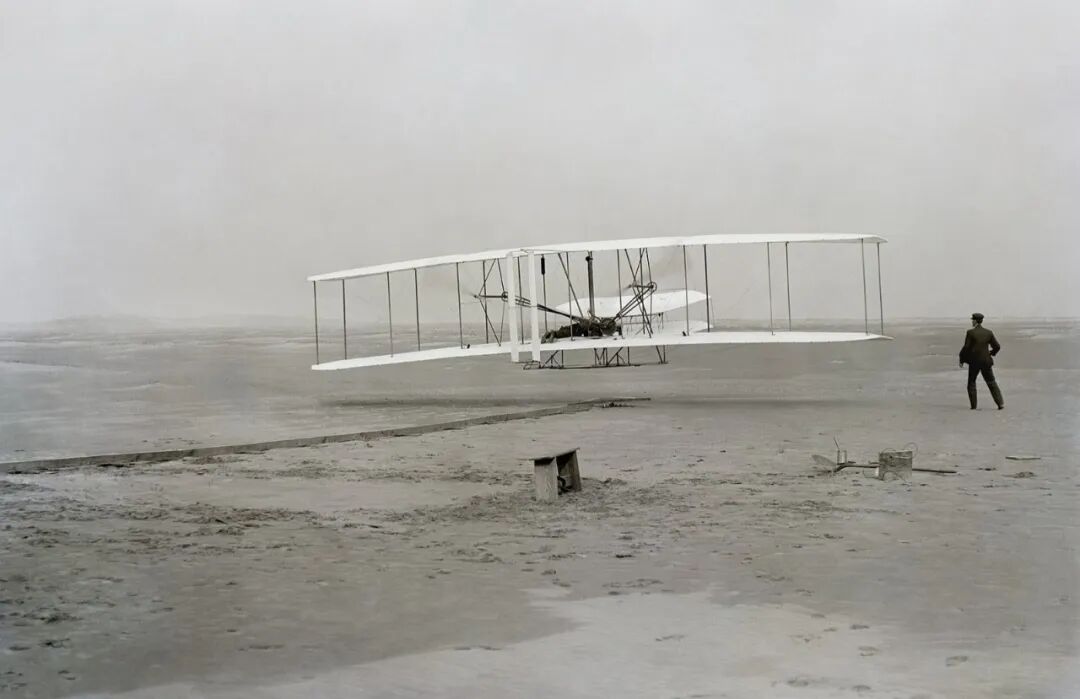
The Wright brothers' first flight lasted twelve seconds and covered less ground than the wingspan of a modern airliner. The author draws the comparison deliberately. That, he says, is roughly where AI in mathematics stands today.
Until this year, these planes were crude. They could fly a few hundred metres, hover a few metres above the ground, cost a fortune, and were useful only in narrow circumstances. In the last few months, they have begun flying into the dense jungle without crashing. Several have even landed on rocks no human climber has ever reached — meaning, in plain terms, that several conjectures have fallen.
He offers a parable. Today's planes are still primitive compared to the planes of a few months from now — let alone a few years. The argument that the planes cannot reach the real summits is, in his view, a static-thinking fallacy. It mistakes the present for the future.
Mathematics Graduates
Once the planes are cheap, the whole jungle changes. Private aircraft become commonplace. Anyone with the money can hire one and land on any rock. Satellite-style surveys map the entire continent's mineral wealth. The scene gets messy. Today's explorers are horrified and accuse big companies of ruining the jungle they loved. They are not wrong, the author concedes — but the corporations will find unimaginable wealth there anyway.
Climbing does not vanish. More amateur explorers than ever charter flights to their favourite rocks, buy ready-made gear, and climb in groups. Less athletic enthusiasts sit in the planes and search for taller ranges, or look down on the whole mountain chain from a height no peak can match.
The atmosphere and excitement of the old days will disappear forever. Mathematics will be more brilliant, more useful, and more ordinary than it was in the heroic-explorer era.
The final section opens with a single sentence of advice: do not bet against the plane. The people who insist that AI cannot generate conjectures, cannot build theory, cannot explain its own reasoning, are describing last spring's models. Anyone whose professional identity depends on "AI cannot do X" is building a house on sand.
Universities, journals, and tenure committees will look broadly similar for a few more years. What they reward will change fundamentally. The heroism of climbing what no one else can climb will matter less than three new competencies: choosing which terrain is worth exploring, commanding formations of aircraft, and explaining the discoveries to the world.
The essay's closing line is also its thesis: mathematics is about to graduate. It will grow into a full industry, become the true foundation of every other scientific and technical advance — no longer a quiet corner of academia.
Not Everyone Wants the Diploma
The reaction has not been uniformly receptive. A few days before the essay went live, the creator of one of the world's most widely used mathematical software packages published a 7,000-word counter-piece. The goals of mathematics, he argued, "almost by definition, must come from outside the system — specifically, from us".
A respected Imperial College mathematician sketched the response of the wider community through the lens of the five stages of grief. He noted that at least one Fields medalist has publicly refused to use AI tools and sworn to hold that line until the end. And then there is the doctoral student, stuck for months on a single lemma, who watched a chatbot produce the proof in one shot. The author of the original essay knows that grief well. He insists the grief is real but will not last long.
The Inscription on Hilbert's Tomb
In 1930, in Königsberg, one of the founders of modern mathematics said six words that were later carved on his tombstone: We must know, we shall know. The Imperial College mathematician quoted the same line at the close of his rebuttal.
What is happening now is not the end of mathematics. It is the moment mathematics stops being the private craft of a few thousand prodigies and becomes the infrastructure on which the rest of the technological stack rests. Whether that survey is led from the cockpit or from the climbing rope will be one of the defining professional questions of the next decade.