
The most consequential breakup in technology happened at a company-wide meeting. Nobody got to leave the building properly.
On a December afternoon in 2020, Dario Amodei stood up in an OpenAI all-hands meeting and announced, alongside six other colleagues, that he was leaving. The policy lead at the time, Jack Clark, typed a single sentence into the meeting chat: I love you all. The screen went black. The seven people in the room were simultaneously removed from the call, their email revoked, their Slack access terminated, and their company laptops remotely locked.
The other side of that exchange is the part that makes the new Atlantic long-form piece worth reading. The seven were not caught flat-footed. They had spent weeks in a private Slack channel planning the launch. Which researchers to bring. Which investors to call. How many GPUs to pre-commit. Even a name for the new company. They called their internal negotiation, with no apparent irony, The Divorce.
The First Crack
Dario Amodei's fingerprints are on GPT-2 and GPT-3. He was one of the early architects of OpenAI's large-model strategy. The fracture with Sam Altman, by his own account, dates back to 2017, and the trigger was a project called Countries.
OpenAI was looking for fresh funding after Elon Musk gradually disengaged. The proposal was to build an international consortium — multiple governments contributing capital to share in the development, governance, and upside of any future AGI. According to five people familiar with the discussions, the proposal drifted toward something more transactional: countries effectively bidding for priority access to future AGI capabilities.
Dario's objection was sharp. The moment you start selling future AGI access to raise money, he wrote internally, you cannot claim to be working on behalf of humanity. OpenAI publicly denies ever considering sales to specific countries; the disagreement is now part of the public record.
What followed was a series of escalating incidents. A longer-than-approved GPT-3 customer list that bypassed safety review. A Microsoft investment agreement that, in Dario's telling, quietly dropped a clause he had been promised. A near-miss product decision in which Kanye West was about to be given early access to GPT-3 before Jack Clark raised the alarm.
None of those incidents, individually, broke the relationship. Cumulatively, they did.
The Veto That Could Not Be
By 2019, Dario had effectively stopped trusting management. He was actively considering a move to DeepMind. A colleague, Jared Kaplan, offered a different suggestion. If you cannot trust any of the existing labs, why not build one?
That conversation cracked the door open. Within months, a private channel called BATNA existed. Dario prepared a final set of conditions for staying at OpenAI. The most consequential was non-negotiable: the safety team he led must have the power to halt any new product release.
OpenAI declined. The negotiation was over before it began.
Hours after the laptop-lockout, the seven met for the first time as employees of a company that did not yet exist. They needed a name. Sparrow Systems was the first choice — a reference to the unfinished fable at the beginning of Nick Bostrom's Superintelligence, in which sparrows bring in an owl without first figuring out how to control it. The domain was taken. They settled on Anthropic.
OpenAI, in a brief and businesslike parting gesture, gave them a few weeks to recruit employees from inside the company, after which Anthropic was barred from poaching for a year.
Two Visions, Two Empires
The original Anthropic plan was deliberately modest. Keep the team around fifty people. Maintain an unusually high talent density. Focus exclusively on large-model research and safety. Back-of-the-envelope estimates put the cost of reaching AGI at roughly ten billion dollars, a number that looked aggressive at the time and quaint today.
By the summer of 2023, Anthropic had about 160 employees. The office had board games, plants, and vegan sandwiches, and someone had built a throne out of Liquid Death cans. Visitors described the culture as half university lab, half well-funded secret society.
Two years later, the company had thousands of employees, a new headquarters, a private jet for the CEO, a security detail, and the kind of internal-circulation printed essays that startups tend to outgrow by their third year. The fifty-person safety lab had, against its own original intent, become one of the two most consequential AI companies in the world.
Jack Clark, a co-founder, has a name for the condition Anthropic now finds itself in: catastrophe of success. The more the company wins, the more problems it has to manage. The faster it moves, the more it risks the very thing it was founded to prevent.
The Mirror Image
The dark joke that runs through the Atlantic piece is that OpenAI and Anthropic are converging into each other. Both are now spending tens of billions on compute. Both are now training models to be polite, careful, and deferential. Both now operate at the kind of scale that makes any single safety decision feel much smaller than the cumulative weight of every decision combined.
Inside both companies, the founders are said to view each other with contempt. One former OpenAI person described the Amodei siblings as people who wanted power just as much as anyone else, but who wrapped the ambition in the language of safety and ethics. Dario, on his end, has been reported to have called Altman and OpenAI evil in private messages, and was urged by an Anthropic communications executive to delete the remark before it leaked.
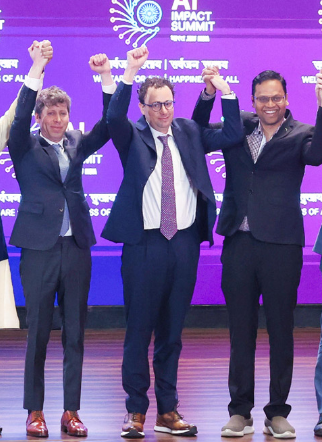
At the Indian AI summit in February 2026, the two CEOs shared a stage. When the cameras asked them to join hands, neither did. They tapped elbows.
The split is now ancient history. The companies that emerged from it are running neck and neck, and their founders cannot stand to look at each other. Both labs are spending extraordinary sums teaching their models how to be honest, respectful, and considerate. The people teaching them that lesson, last time they were on stage together, could not bring themselves to touch.
Whatever else comes out of the rivalry — and a great deal will — that image alone will outlast most of the technical milestones.